Episode 184 Show Notes
 Episode 184. With a new year fast approaching—and an astonishing five years of podcasting under our belts—we thought it was the perfect time to go back to basics. In this episode, we revisit some of the cornerstone concepts of sake, offering a concise refresher on ingredients, classifications, and production.
Sake remains a niche category in the world of alcohol, and every day new fans are looking for a clear, approachable foundation. Our hope is that this episode provides helpful insight and practical knowledge to support the beginning—or deepening—of your sake journey.
Here’s to a great new year filled with more sake learning, tasting, and plenty of fun along the way.
#SakeRevolution
Skip to: 00:19 Show Opening
Welcome to the show from John and Timothy
Skip to: 03:54 Back to Basics Introduction
Skip to: 04:49 Sake Ingredients

Skip to: 08:14 Sake Classifications
Skip to: 13:07 Sake Production

Skip to: 18:18 Sake Tasting: Brooklyn Kura Tidal, Macho King Yamada
Brooklyn Kura Tidal Junmai

Alcohol: 17.0%
SMV: +3
Brewery: Brooklyn Kura
Production Area: Brooklyn, NY
Classification: Junmai
Importer/Distributor: Skurnik
Rice Type: Calrose
Rice Milling: 50%
Macho King Yamada

Alcohol: 15.0%
Brewery: Makino Shuzo
Prefecture: Gunma
Classification: Junmai
Importer/Distributor: Namazake Paul Imports
Rice Type: Yamadanishiki
Rice Milling: 80%
Acidity: 1.7
Skip to: 30:27 Show Closing
This is it! Join us next time for another episode of Sake Revolution!
Announcing Patreon
 Now there is a new way to support Sake Revolution. Join us on Patreon! Patreon is an online platform that allows you to support your favorite creators by subscribing to a monthly membership. At Sake Revolution, we’re offering two tiers, each with its own perk. If you enjoy our sake podcast, if you are able, please consider supporting this labor of sake love! See below to learn about our Patreon support levels.
-
Sake Enthusiast
Have you ever wanted to sip along with us as we taste our sakes on the podcast? Now you can! As a Sake Enthusiast patron, you’ll get the inside track and know in advance which sakes we’ll be featuring on the show. This allows you to get them on hand and sip along with us while you listen.
-
Sake Otaku
As a Sake Otaku supporter of the pod, you’ll get access to all the Sake Enthusiast intel along with access to a monthly live zoom Sake Happy Hour taking place the first Weds of every month at 9pm ET (6pm PT). Visit with us live on zoom! Come with all your questions and suggestions and enjoy a relaxed and fun Happy Hour with with us as we all sip sake together!
Episode 184 Transcript
John Puma: 0:21
Hello everybody and welcome to Sake Revolution. This is America’s First Sake podcast. I’m your host, John Puma. I’m from the Sake Notes. Also run the internet sake Discord, as as well as Reddit’s r slash sake community.
Timothy Sullivan: 0:35
And I am your host, Timothy Sullivan. I’m Sake Samurai. I’m the Director of Education at the Sake Studies Center, as well as the founder of the Urban Sake website. And John and I will be here tasting and chatting about all things sake and doing our best to make it fun and easy to understand.
John Puma: 0:51
Oh, hello there, Tim.
Timothy Sullivan: 0:54
Hey John, good to see you.
John Puma: 0:55
Likewise. How you doing? I think this is the last episode of the year for us. And how’s your sake year been?
Timothy Sullivan: 1:03
It’s been very good, busy and I’ve been teaching a lot of sake classes, tasting a lot of fun sake, a few trips to Japan and it’s been a great and fun sake year all around. How about for you?
John Puma: 1:17
same here. Had a wonderful time. Ended up going up to Boston for Sake Day, which was a lot of fun. Did I had just the one trip to Japan, though. You’re way ahead of me on that. But it was nice to see you there, which was a lot of fun as well. Yeah, great sake year all around. And I’m really excited about what you,’cause this is a very much a Tim driven. Concept today, what you put together for today and what you wanted to do. And I think it’s a really fun thing and I’m super excited to to get rolling with it. So why don’t we talk about what you’re doing?
Timothy Sullivan: 1:48
Yeah. I teach classes all the time
John Puma: 1:50
I have heard that.
Timothy Sullivan: 1:51
Yes, and it’s a lot of fun. And I love meeting people who are just new, just getting into sake, just starting their sake journey and a shameless plug, but one thing I do is I always recommend our podcast and I realize that. Yeah. And. It’s good for people to listen to if they want to get into sake tasting or learning more about different aspects of sake. But I was thinking about it, and we’ve been doing this for five years now. We started in 2020 and I was thinking we haven’t really gone back and revisited the basics. So I thought that. It might be fun to do one episode around five years in that kind of capsulates all the learnings we had about the basics of sake. So if you find our podcast more recently and you want just a quick primer into what you need to know about the basics to start to dive in and enjoy sake, I think I thought that would be a really fun episode to make. Just a quick overview of what the basics are, how to get started and get your feet wet in sake, so to speak.
John Puma: 3:03
Sounds good to me. Getting my feet wet, i think that like when we started this show. We did a series on, a lot of the a lot of the intricacies of making sake and and that big overview and it’s fun to, to return back to these ideas and to to go over them again for folks who have. Who were not with us at the beginning and haven’t gone back and listened to the first few episodes. I also think that you and I have probably matured as hosts in that time, and I think that maybe the product that we put out today might be better than what we did five years ago.
Timothy Sullivan: 3:39
I feel like a very well matured host. Myself,
John Puma: 3:42
All right.
Timothy Sullivan: 3:44
Like a good piece of cheese. I am well matured. Yes.
John Puma: 3:48
piece of cheese. I’m glad, Tim, that I’m glad you are a good piece of cheese.
Timothy Sullivan: 3:54
Yeah. We, yeah, that, that’s the other you make a really good point, John, because when I would refer people who are just beginners and I’m like, oh, I do this podcast about sake. I’m like, oh, you can start at the beginning. And I realized that, we broke up so much of the sake 1 0 1 stuff over multiple episodes. So if you wanna learn about sake ingredients, you basically have to listen to four episodes to get the whole picture. So I thought, why don’t we do a quick summary of the basics you need to know. This is our back to basics episode. So if you’re just getting into sake and want a quick primer, this is it. So I think we should dive right in.
John Puma: 4:33
That sounds good to me.
Timothy Sullivan: 4:35
Yeah, so John, you’re gonna help me. You’re gonna be the man on the street as usual,
John Puma: 4:42
Hello. Nice to meet you.
Timothy Sullivan: 4:44
so. Man on the street I’ve never met before.
John Puma: 4:48
Yes, I, who is this man?
Timothy Sullivan: 4:49
I think one, one thing that is really important to start with, and I thought about a lot about the progress of these topics. You know, When someone asks you at a cocktail party, give me the five minute rundown. What is sake? I’ve gotten that question before, and I always start with sake, ingredients, what goes into sake. John, you know the answer to this. So tell us what are the ingredients in sake.
John Puma: 5:10
It’s funny. You should say that because just so I don’t forget, I actually have it all printed on a t-shirt. So it
Timothy Sullivan: 5:15
That’s right.
John Puma: 5:17
Yes it is water, rice, yeast, and Koji.
Timothy Sullivan: 5:20
That’s right. And I think water, yeast and rice, we don’t have to go into too much detail. I’ll talk a little bit about rice in a second, but the one that is most unfamiliar to most people is Koji
John Puma: 5:34
I agree. I think that’s the one that throws people for a loop. They’re like, okay, I know what rice is, I know what water is. I’ve got an idea about yeast, but what is Koji?
Timothy Sullivan: 5:44
Yeah, so Koji is a type of mold and it gives off an enzyme that breaks down starch into sugar. So this is how we get sugar out of the starches and rice and the. Analogy in the beer world would be malting grain. So if anyone has a concept of what malt is in the beer the idea of breaking down starch into sugar in the sake world, we do that with this fungus called Koji. And that’s, we don’t need to dive any deeper than that. Just understand that koji is a way that we get enzymes into the mash that break down starch into sugar, and we need that sugar. So that the yeast can convert sugar into alcohol. So that’s our two step fermentation that we have with sake.
John Puma: 6:27
Yeah. Whenever people ask me like, oh like. Why Koji? Like why is not just doing it? And I’m like where do you think the sugar is coming from? Because you need sugar to make alcohol and there is no sugar in rice, so you need something that’s gonna change that. And that’s what the magic of of Koji is making sugar where there was none.
Timothy Sullivan: 6:47
Yes, exactly right. And the only thing I want to say about Rice is that we have some specialty strains of rice that are specific for sake making, and they have a unique characteristic to them. Do you know what that is, John?
John Puma: 7:04
So the important thing about sake rice is that all of your starches are towards the middle,
Timothy Sullivan: 7:09
That’s right.
John Puma: 7:10
towards the center of the rice grain.
Timothy Sullivan: 7:13
Yeah, so we call that shinpaku or the white heart, and it’s a starchy core. So sake rice has this starchy core, and that’s so important because it allows us to mill the rice and isolate the starch in the center. So milling or polishing down rice is one of the key cornerstone concepts in sake. The smaller you mill the rice down, the more premium and the more expensive the sake’s gonna be. So that’s another point I always mention when I’m giving people the quick overview of sake. Rice is milled or polished before brewing, and the smaller you mill the grain, the less of the grain remaining, the more premium and the more expensive the sake’s gonna be.
John Puma: 7:53
Because you’re losing part of the product when you’re milling it down. If you have, if you have 10 kilos of rice and you mill it down to 50%. You have five kilos of rice and so on and so forth. Meanwhile, if you mill it down to, oh, let’s say 75%, you have that much more to work with.
Timothy Sullivan: 8:14
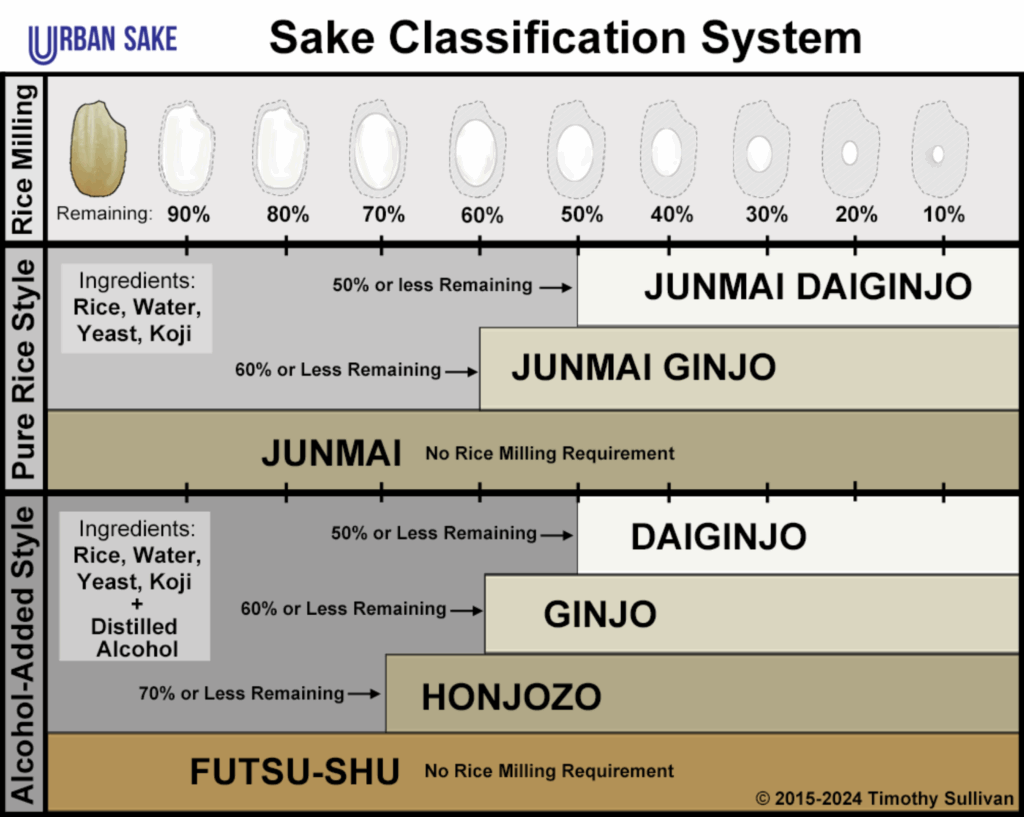
Yeah, that’s exactly right. And that takes us to the next topic, which I think is important, which is sake classifications. And this is a little bit more complicated, but I like to explain that. The smaller you mill the rice, the more premium your sake can be considered. And we have, classifications that are based on the milling ranges. Junmai is the entry level to premium for the pure rice style. And then we have Junmai Ginjo, that’s the middle grade of premium. And for that, the rice has to be milled to 60% or less remaining. And then for the super premium sake, that’s called Junmai Daiginjo. And that is. 50% or less remaining. Those are the three grades on the Junmai Style, and those are sakes that are made with rice, water, yeast, and Koji only. So that is a good place to start if you’re just getting into sake.
John Puma: 9:09
Okay. Now wait a minute, Tim, I know for a fact I’ve heard from people, other people on the street that there’s another kind of sake where there is another ingredient and that is a neutral spirit. What’s that all about?
Timothy Sullivan: 9:23
Yeah, there is another, there’s another chart of classifications which exists in parallel to the Junmai styles, and that’s called Aruten or Alcohol added Sakes. And these sakes have an optional fifth ingredient, which is jozo alcohol or brewer’s alcohol. It is a neutral spirit, as you mentioned, and that is added on the last day of fermentation, and it can affect the flavor, texture, and aroma of the sake. So for beginners, all you need to understand is that some sakes have distilled alcohol added, and this is called the alcohol added style, and some sakes are considered pure rice and they don’t have that added alcohol. And these two systems exist in parallel and one is not considered more delicious or more premium than the other. They are both very delicious styles of sake. And you just need to be aware that some sakes are in the Junmai category, and some are in the alcohol added category.
John Puma: 10:23
Now wait a minute, Tim, we’re adding alcohol to my alcohol. Is that gonna make it higher in alcohol?
Timothy Sullivan: 10:29
That’s perfectly logical, and I hear that all the time, but most sake has water added to it at the time of bottling, so they can bring the alcohol level down, whether it’s the alcohol added or the pure rice style.
John Puma: 10:42
Okay.
Timothy Sullivan: 10:43
Yeah, and let me quickly just mention the classification names for that alcohol added side. The entry level to premium is called Honjozo. That’s 70% or less remaining a little bit different from Junmai. And then we have Ginjo that’s 60% or less remaining. And then Daiginjo, which is the super premium, 50% or less remaining. If you would like to see a chart of these classifications, just visit our show notes at SakeRevolution.com.
John Puma: 11:10
Great. Now my understanding though is that there’s sake that is milled way down much further than 50%. Is that still just called Junmai, Daiginjo or Daiginjo?
Timothy Sullivan: 11:19
Yeah, you can mill or polish your rice down well below 50% remaining There’s sake made with rice polished down to 35% remaining, 23% remaining, 7% remaining. And there was almost an arms race in the sake world a few years ago. How low can you go?
John Puma: 11:38
Yes. I used to call that stunt, seimaibuai just like, like hell. This one is this one is 6%. Ooh. It’s like basically dust at that point.
Timothy Sullivan: 11:49
Yeah. So my, my advice to people just getting into sake is don’t chase the milling rate. Just e experience the sake. Yeah. Experience the sake for what it is, and you’re gonna find styles that you like, that you jive with. And the milling rate is. Interesting supplementary information, and it’s good to know what differentiates honjozo from a Daiginjo. But it shouldn’t lead you necessarily as your very first consideration when picking a sake.
John Puma: 12:20
I agree wholeheartedly. I think that’s something that people get wrapped up in a lot of the time.
Timothy Sullivan: 12:26
Yeah. And when you’re learning about sake, you want something to grab onto. You want something to guide you. And the milling rate is a, it’s a number that you can focus on and I understand it’s only natural to want to find a number and say okay, this is what I have to get the most polished. But it’s really not a recipe for getting the best sake you can get.
John Puma: 12:49
And Maybe at one point it meant a little bit more. But I think that these days, the technique that we have that brewers have they can do so much with without having to make something ridiculously well polished. Even though we talked about that arms race that took place not that long ago.
Timothy Sullivan: 13:07
Yeah, it’s an interesting aspect of sake, but it shouldn’t be the thing that guides all your decisions about which sake to drink. In addition to the ingredients and classifications, I want to give a really brief. Outline into how sake is made. And this is just a quick overview. We basically take rice, we wash it, we soak it, we steam it, and then we take that rice and we do a fermentation starter to get the fermentation kicked off. This is a small batch of sake that takes about two weeks to make in the tank, we put in water, we put in the Koji rice. That’s that. Rice with the mold grown on it. We put regular steamed sake rice and we put all the yeast in on the first day. And this small mini batch of sake is our starter, and that takes about two weeks. And when that is done, we transfer the starter to the large sake tank. We add more water, more koji rice, and more regular steamed sake rice. And then that ferments for about an additional 25 to 30 days. And that’s the main mash. And what’s happening during that time is that starch is breaking down to sugar and then the yeast is in there to eat the sugar and make the alcohol. So it’s a two step fermentation process that is unique in the world of alcohol. It’s really cool when you slow down and study it a little bit, but that is how we get the alcoholic fermentation starch to sugar to alcohol, and then. When we’re done with the fermentation, we press the mash, it gets pasteurized, bottled, we add a little water and then that sake is ready to go.
John Puma: 14:49
Excellent. Excellent. Now how long are we talking from end to end here?
Timothy Sullivan: 14:54
It depends. There are some periods of sake making, like after pressing, you can age between three to six months. Some breweries do that religiously. Some skip that if they wanna release a fresh batch. So anywhere from two to three months generally is the timeframe you’re talking about from beginning to end?
John Puma: 15:14
Okay. Very cool.
Timothy Sullivan: 15:16
Yeah. And then. The only other thing I would mention is that there are a variety of sake styles beyond the classifications depending on different choices you made during the sake production. And I think there’s a few we should talk about real quick. The first one that I get asked about all the time is nigori sake.
John Puma: 15:37
Yes.
Timothy Sullivan: 15:37
Yes. So a lot of customers call this unfiltered or cloudy style. We don’t say unfiltered on this show, but
John Puma: 15:45
We do not Absolutely true.
Timothy Sullivan: 15:48
technically not unfiltered, it’s coarsely filtered but little bits of rice starch from the mash get into the final product and make it cloudy. That’s a really popular style. And the other one I wanna mention very quickly is nama sake. What is nama sake?
John Puma: 16:03
NAMA is sake that has not been pasteurized, which means that it is still. It’s active in the bottle. It’s still a lot more subject to change as far as flavor goes, and you’ve gotta care for it a little bit differently. Definitely a little bit more than you need to take your regular sake care. So generally speaking with sake, most sake, is relatively shelf stable, although we do always recommend putting it in a refrigerator and keeping it in the dark. But with nama, we strongly recommend that you put in a refrigerator and keep it away from light and keeping it in the dark. Tim did I sum that up pretty well?
Timothy Sullivan: 16:40
You’re hired.
John Puma: 16:41
All right. Yeah.
Timothy Sullivan: 16:44
So nama, as you said, is our unpasteurized style, and it does need to be refrigerated, but you can get rewarded for that extra effort by having something that’s really juicy and fresh and very zingy and zippy. And two other kinds I wanna mention real quickly are Kimoto and Yamahai. These are styles that use an old school. Yeast starter method, and these produce more earthy, funky and bold, umami driven sakes, traditionally. Kimoto, Yamahai, nama, and nigori, these are all styles that you can look out for. And these styles are based on. Production steps. So they’re separate from the classifications we talked about earlier. So you can have a Junmai nama, you can have a Junmai Daiginjo nigori. You can mix and match these based on what the brewery’s producing. That’s another thing I’d like to point out is the difference between classifications, that’s rice milling and ingredients, and the styles. Those are production steps that affect the outcome of the sake. All right.
John Puma: 17:47
That was a sprint through the steps of what is sake a sprint through the basics of sake, just as promised. And I think that you should be rewarded for your efforts by getting to sip some delicious sake.
Timothy Sullivan: 18:00
Yeah, so you and I both brought. So the brief was if you were gonna introduce someone to sake who was just getting started and gonna hear this 15, 20 minute introduction let’s bring a sake along to taste with them and is it all right if I introduce the sake I brought.
John Puma: 18:17
Absolutely.
Timothy Sullivan: 18:18
Absolutely. Yeah. So I brought a bottle from Brooklyn Kura. So this is a domestic sake, and this is made right here in New York City. The one that I brought is one of the new Brooklyn Kura Junmai sakes. This is called Tidal. It’s made with a hundred percent Calrose rice. That’s a domestically grown eating rice that’s grown in California. And the polishing rate, the amount that they milled this down is 50% remaining. The alcohol percentage is 17% and the sake meter value is plus three and. Tidal refers to the ebb and flow of the tides and the connection between the earth and water. And Junmai is the entry level to premium, and it is a great place to start when you’re introducing people to sake. I love to taste them on a junmai. It introduces the concept of pure rice sake. And this is the one of the. Entry level classifications and it gets people grounded in sake and gives them a great first introduction to the pure rice style. So that’s why I chose the new title from Brooklyn Kura.
John Puma: 19:32
I like that.
Timothy Sullivan: 19:33
And what do you have, John?
John Puma: 19:34
So I have something, it’s a little bit new to the States, but it is a sake that I always recommend. Whenever somebody’s oh, what should I’m going to Japan, what should I try? And I always say, oh, if you see this sake, you should definitely have it.’cause I think it’s a great and a great intro sake. I think that it’s a, it has, it, it paints a wide. Paints with a wide brush we’ll say. So this is the macho King, yamada Junmai. Now, we talk a lot about, on this show about sake, rice varieties and Yamadanishiki is the most popular sake rice that’s made that’s used in Japan for premium sake. And so king, it’s sometimes referred to as the king of sake rice. So King Yamada. Haha, you This is from Makino Sake Brewery in Gunma. It’s apparently the oldest sake brewery in Gunma. This Yamadanishiki is milled down to 80% of its original size, so it’s a little less polished than usual. The acidity is 1.7 and the alcohol is 15%. So yeah. Tim, why don’t we get that Tidal in a glass?
Timothy Sullivan: 20:43
Yeah. So one thing I wanna point out, John, is that the milling rate on your sake and my sake are very different, but they’re both sold as Junmais.
John Puma: 20:51
That is absolutely true.
Timothy Sullivan: 20:52
Mine is 50% remaining, which we mentioned was the threshold for Junmai Daiginjo. But one thing about this classification chart is that you’re not required as a brewer to move up to the highest level you qualify for with your milling. So the brewers can choose to. Once they meet that minimum requirement, they can choose to sell it in whatever of the classifications they feel best, identifies their sake. So if it’s uh, usually more rice forward, more structured they may sell it as a Junmai, even if it qualifies as a Junmai Ginjo or beyond. You have an 80% milling rate, which is very rustic and very full-bodied, especially for Yamadanishiki. I have a 50% on my Junmai, so keep that in mind. Again, we can’t be slaves to the rice milling percentage. No.
John Puma: 21:43
I like that we brought that up earlier, that the rice milling percentage really needs to be something you don’t marry yourself to.
Timothy Sullivan: 21:48
Yeah. Okay, so I’ve got my title. I’m gonna get it in the glass.
John Puma: 21:52
Or I’m gonna get my macho in the glass
Timothy Sullivan: 21:55
Macho, what a great name.
John Puma: 21:57
is and when you look at the show notes, please please do. These labels are, it’s like a cartoony graphic of a, of an, of a, an older man flexing, and in this case, because it is the Amada, he has a crown because he’s the king.
Timothy Sullivan: 22:12
The king.
John Puma: 22:13
I.
Timothy Sullivan: 22:15
All right, I have my Tidal, Junmai in the Glass. I’m gonna give this a smell. So the aroma is relatively light here. It’s not super strong, a little more reserved, but it is a rice forward. And if you think about calrose is actually an eating rice that you know is used a lot in the states. And you get a little bit of that hint of rice aroma. It wouldn’t be Brooklyn Kura if it was, there wasn’t a hint of some fruitiness as well. So it’s a good blend of a gentle very light tropical fruit and some ricey-ness. How about Mr. Macho?
John Puma: 22:54
Mr. Macho is is fruity. The aroma is very like pineapple, like a tropical fruit with a little bit of acidity, a little zing to it. And it’s a really lovely aroma. The aroma on this. And then we, this is a Junmai as it’s milled to, 80%, but the aroma I get on those, it’s a little bit more like a Junmai Ginjo. Even though in, in your sake I would say is has that 50% milling, but where do you think when you do the aroma on that, what do you think that would be if if nobody told you what they were marketing it as?
Timothy Sullivan: 23:28
Yeah, I would never mistake this for a Junmai Daiginjo, I don’t think, because it is not super expressive in the aroma. It’s more reserved and straightforward and a little Rice-y and my mind goes to, June Junmai just based on the aroma alone.
John Puma: 23:45
And then for me, based on this aroma, I would never think this was a Junmai I would think it was something something more elevated.
Timothy Sullivan: 23:51
Yeah. I’m gonna give mine a taste. again, the Tidal from Brooklyn Kura. Yeah, so this has good structure. Definitely rice forward. Again, just that back note of something fruity and a little bit juicy, but really good balance with the acidity. I think the. Rice story, the calrose comes across in a very elegant way. This feels, as we often say on this podcast, this feels like a very food friendly style of sake. This is a bottle you could so easily open when you have friends over for dinner, and you just want something easy, clean, balanced to sip on with pretty much any kind of food like this feels like a sake you could pair with such a wide variety.
John Puma: 24:37
Lovely. Very cool.
Timothy Sullivan: 24:40
And the SMV is a plus three, so this is a really good balance between sweet and dry. It’s not bone dry, but it’s not super sweet either. It’s striking that really good balance that brings roundness to a Junmai Sake, and as Brandon does so well the rice flavors from the calrose are so well integrated. So great all around. Super easy drinking.
John Puma: 25:04
Excellent. And that’s Brandon Brandon Doughan our friend of the show who who’s been on many times. He’s the Toji over Brooklyn Kura.
Timothy Sullivan: 25:12
Yes, that’s right.
John Puma: 25:14
All right. Now I’m gonna sip on the macho king, Yamada Junmai from Makino Sake brewery. So the body on this is significant. Like it is. It is a little on the thicker side. And the flavors are your tropical mix. You’ve got some pineapple, you’ve got some I don’t know if I would say not so much melon in this case, but maybe some apple also and, and some banana. I think in a former life, I would maybe have said some circus peanuts, but I don’t do that anymore. Definitely some banana here and there is a fun little bit of effervescence. It’s not sparkling, but it’s a little bit frizzy, a a little bit fizzy. And that is very pleasant to me on the tongue. And it helps to keep that full body nature from being too cloying and too thick. So very nice, very drinkable. This is Jo oops. I accidentally had the whole bottle kind of sake for me. Very easy drinking sake.
Timothy Sullivan: 26:16
So if you ever get an introduction to sake from Man on the Street, John Puma, you can ex, you can expect some tropical fruits in there. I think that’s the takeaway
John Puma: 26:24
Absolutely. Absolutely. If Man on the street, John Puma ever tries to introduce you to, okay, you, you best be ready for some tropical fruit.
Timothy Sullivan: 26:35
Awesome. I think we hit a new land speed record in introducing sake.
John Puma: 26:41
I think so. I think you’re absolutely right.
Timothy Sullivan: 26:44
yeah, but I really firmly believe that it was a good idea to do this episode and give people a episode. We can point to that, say, do you want a 20 minute introduction to sake? This is the episode and I’m so glad we circled back and went back to basics for today.
John Puma: 27:03
Me too. It’s a lot of fun to go back to basics. It’s a, I’m not gonna lie, sometimes it’s a little bit challenging coming up with new episode ideas all the time. So going back and redoing concepts that we’ve done in the past. But doing it through the lens of things we’ve learned over the years is I think a lot of fun.
Timothy Sullivan: 27:20
Yeah. One last thought I’ll leave you with John is that people listening to this who may be who are in the industry and who are experts the majority of people out in the world have zero knowledge of sake. So I think having this information out there is really important, but the fun really comes in. If you get intrigued by any of the aspects of sake that we talked about, there is an unlimited, well you can tap of learning and tasting and exploring. So this is really for all those people who are just getting started. You can consider this like a springboard to like dive into whatever. If you’re intrigued by the concept of. Rice milling. You can explore there. If you heard the word nigori and you’re like, what’s that all about? You can explore there. We talked about different rice varieties, you can start tasting those. So there’s, that’s one thing that got me really into sake as a hobby in the beginning was learning that there’s so many aspects and you can explore all of them. In different ways on your own timeline, and that’s what made sake really compelling and interesting to me. So I hope that will be true for others as well if they listen to this episode and start tasting different things.
John Puma: 28:31
I think that’s great and for. Me, it was, I had a very similar thing where you dip your toe in, you start to learn a little bit, and you’re like, I’m just gonna learn the things, the basics. And then you realize like there’s no end. If you expand out what that, what basics mean you can be educating yourself for years on that idea. That’s really a lot of fun. That’s the they hook you in with the, oh, it’s just water, rice, yeast, and Koji. But then there’s so many little things that it’s fun to learn about. That’s the best, that’s the best part about sake education for me is that it actually is a lot of fun. I enjoy it.
Timothy Sullivan: 29:05
It is a lot of fun and I’ve, over the years I’ve realized that sake’s not gonna be the favorite drink of everyone who tastes it. But for those people who catch the bug and they become passionate about sake, it’s so wonderful to be, a place where people can come and listen to more about sake, listen to some tastings and dive a little bit deeper into different topics. So it makes, doing this podcast also very fulfilling and a lot of fun. And I agree with you. There is no end to the study. You can do. You can go as deep as you want or as shallow as you want. And at the end of the day. When all is said and done, it’s really about the enjoyment of sake. So if we can help transmit that to people, then I think it’s a job well done.
John Puma: 29:51
I hope we do. I hope that people listen to the show and then they wanna learn more and wanna try new sakes. And yeah. It’s, I think that’s a lot of fun. And for me that’s the joy I get from it is getting to take my enthusiasm and try to share it with people.
Timothy Sullivan: 30:03
Awesome. We may schedule a few more Back to basics episode. This was the overview, back to basics overview, but I think that we may do a few more back to basics episode in the new year and keep a lookout for those. But until then, John, I just wanna say thanks for tasting. I wish I could try that macho, but I’ll get some of it. ASAP.
John Puma: 30:24
I think you’d really enjoy it. So yeah I’m excited to share this with
Timothy Sullivan: 30:27
Yeah. Yeah. So great to taste with you, and I want to thank all of our listeners so much for tuning in. We really do hope that you’re enjoying our show. If you’d like to support Sake Revolution, the best way to do that is to join our community on Patreon. Please visit patreon.com/sakerevolution to learn more
John Puma: 30:47
And If you like our sake podcast so much that you’d like to wear something about it, so people walking on the street, you run to people on the street who are wearing Sake Revolution swag. Maybe you might wanna know where you can get some and you can get your sake Revolution swag at Sake Revolution. Dot com along with our show notes pictures of our bottles that, that macho label, you have to see it, it’s really a lot of fun. So please head on over to sake revolution.com and maybe grab a t-shirt or a sticker. And before I forget, a long time ago, Tim, we said that if people run into us at events, we will have stickers for them. And I recently experienced this and I was ready. So it happened. I had the stickers. They were very happy.
Timothy Sullivan: 31:32
Alright.
John Puma: 31:34
So yeah. On that note, please grab a glass. Remember to keep drinking sake and Kanpai!